
- Products
Turnouts
A set of devices that guide the train from a straight track to ...
Turnout components
A turnout is composed of forged, casting, machined ...
Fastening systems
A fastening system in a turnout consists of: screws spikes, ...
Buffer stop
A buffer stop is a device, installed at the end of rail tracks...
Rail Expansion Joint
The Iran Rail Industries Development Company, ...
- Services
- News and Articles
- Projects
- Irid Group
- Contact Us
- > News and Articles
- > US–Israeli Attack on Industrial Facilities Is an Attack on Workers’ Livelihoods


Related Articles
US–Israeli Attack on Industrial Facilities Is an Attack on Workers’ Livelihoods
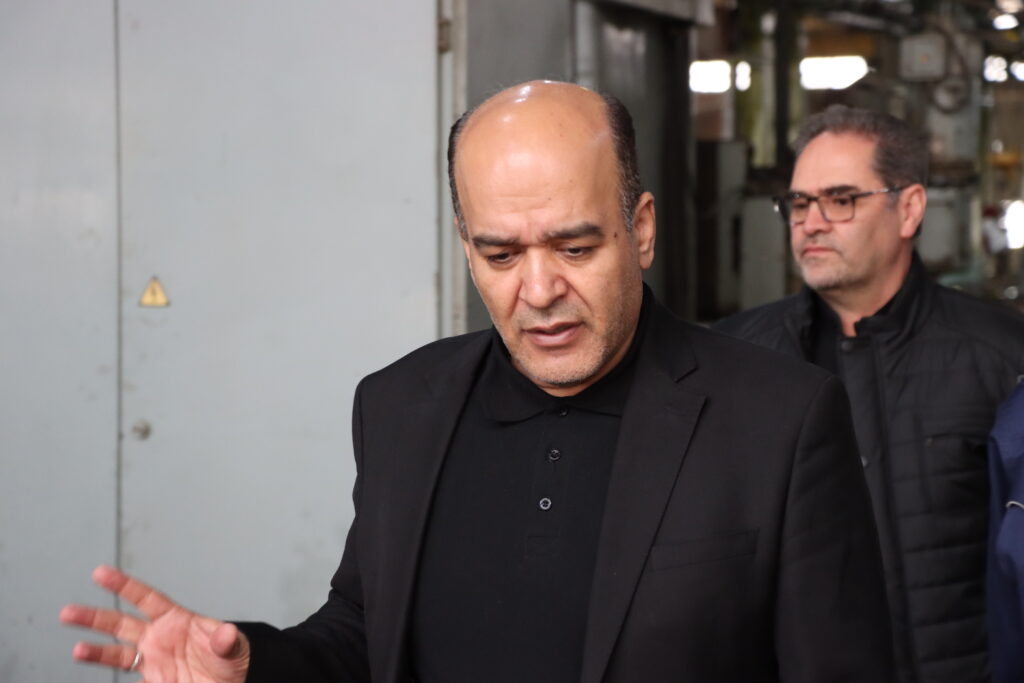
The CEO of Iran Railway Industries Development Company (IRID), a knowledge‑based enterprise, stated that the heartbeat of Iran’s rail industry lies in Tabriz and emphasized that attacks on industrial facilities ultimately target the livelihoods of the working class.
According to the company’s Public Relations Office, Mohammad Kalami, CEO of IRID, commemorated those who lost their lives during the recent US–Israeli attacks and said: “Today we can confidently say that the pulse of Iran’s rail industry beats in Tabriz. Thanks to the determination and resilience of IRID employees who continued working on the production front during the days of aggression by the United States and the Zionist regime, the cycles of the country’s rail industry continue to operate with strength.”Highlighting the region’s significant industrial position and IRID employees’ commitment to national production, he added: “Just as we witnessed the perseverance of IRID personnel during the 12‑day war while maintaining production, today we once again see the industrial strength of IRID in the rail transportation sector.”Referring to IRID’s achievements, Kalami noted that the company received the **National Production – National Pride Award** and the **Golden Statue of National Industry and Mining Day in 2025 (1404 in the Iranian calendar)**. “By relying on domestic capabilities, IRID has broken production records, and the path toward further growth and development in Iran’s railway industries will continue in 2026 (1405).”He added that recent achievements in increasing production capacity and improving quality at IRID represent an important step toward developing knowledge‑based industries and achieving national self‑reliance in the rail sector.Kalami emphasized that rail transportation, as one of the safest industrial sectors, can play an effective role in maintaining service stability and sustaining economic activities even during crises and wartime conditions.Condemning the attacks on the country’s industrial and production centers, the IRID CEO described such actions as a clear violation of accepted international norms and principles. He stated that, under international law, production facilities are considered prohibited targets and that any attack on such centers constitutes a clear example of a war crime—an action that threatens not only economic security but also social stability.Explaining the broader impact of such attacks, Kalami said damage to a production unit rarely remains confined to that facility alone and quickly spreads to other dependent sectors. In many cases, these attacks can disrupt critical infrastructure and trigger a chain reaction leading to the shutdown of other production units, effectively putting an entire production ecosystem at risk.He further stressed the human and social consequences of such actions, noting that attacks on national industries do not only halt production lines but also directly affect the livelihoods of workers and their families—an impact that extends far beyond purely industrial damage.“An attack on industrial centers is, in reality, an attack on the dinner table of the working class,” Kalami said. “The working community has always driven the wheels of production and industry through its effort, expertise, and labor. Any harm to this sector directly targets the livelihoods and lives of these hardworking people.”Emphasizing the national responsibility of those involved in production, he added: “Maintaining stable production today is not merely an economic mission; it is also a national and social duty. We stand on the production front to protect workers’ livelihoods and, by sustaining industrial activities, to help strengthen the overall welfare of society.”Kalami also referred to supportive measures in the labor and production sector, describing the **60 percent increase in workers’ wages this year** as a positive step toward improving workers’ living conditions. He noted that such policies, alongside continued production and support for industries, can contribute to improving welfare and reducing economic pressure on hardworking segments of society.**End of News**